
Play Tower Rush Now!
Home → Demo
Tower Rush Demo
What the Tower Rush demo gives you
The Tower Rush game by Galaxsys offers a theoretical RTP of 97.00%, establishing a house edge of 3.00% for long-term play. This percentage represents the expected return over hundreds of thousands of rounds, ensuring transparency in payout expectations. Players can verify fairness through provably fair hash verification, which guarantees that each round result is random and untampered.
Comparing this to Aviator by Spribe, which also features a 97.00% RTP, Tower Rush provides a similar baseline return but with a distinct tower-building mechanic. While Aviator allows wins up to x1,000,000, Tower Rush caps its maximum win at 100x, limiting the potential payout ceiling significantly. This structural difference affects risk management strategies for players seeking high-variance outcomes versus steady returns.
The demo environment mirrors these exact parameters, allowing users to test the auto cashout feature without financial risk. By observing the rising multiplier curve, players understand how quickly the crash can occur before reaching the 100x limit. This simulation helps users gauge their tolerance for volatility before committing real funds to any operator offering this specific title.
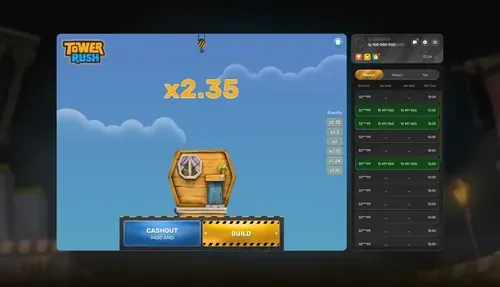
Starting the demo without registration
Accessing the Tower Rush demo requires no registration or deposit, providing immediate entry into the Galaxsys platform interface. Unlike real-money accounts linked to operators like those offering Chicken Road by InOut Games, this mode isolates the gameplay from personal data collection. Users can initiate a round instantly, focusing solely on the mechanics of stacking floors and managing the cumulative odds.
The absence of KYC checks in the demo phase contrasts sharply with real-money play where identity verification becomes mandatory for withdrawals. While real accounts demand compliance with regulatory standards, the demo version operates as a pure testing ground for the 97.00% RTP mechanics. This separation ensures that players can experiment with bonus floor types like Frozen Floor without any legal or administrative hurdles.
Testing the Triple Build bonus floor in demo mode reveals its impact on the cumulative multiplier progression without risking actual capital. The visual feedback provided by the hash verification process remains identical to the live version, maintaining integrity in the demonstration. Players can thus evaluate the provably fair system's reliability before deciding whether to engage with operators hosting this crash game.
Demo balance and bet sizes
The demo balance typically starts with a fixed virtual amount, such as 100 €, which resets upon page refresh or session end. This simulated currency allows players to adjust bet sizes freely, exploring strategies within the constraints of the 100x max win cap. Unlike real deposits subject to operator limits, the demo balance imposes no minimum wager restrictions, facilitating unrestricted experimentation.
Comparing this flexibility to Rabbit Road by InOut Games, which has an RTP of 95.50%, the demo highlights Tower Rush’s higher theoretical return. Players can place multiple small bets to observe hit frequency or larger bets to test the auto cashout trigger near the 100x limit. This variability helps users determine optimal stake levels relative to their bankroll management preferences in a risk-free setting.
The ability to reset the balance encourages repeated trials of the Temple Floor bonus type to assess its contribution to overall variance. Each reset restores the initial virtual funds, mimicking the continuous flow of real-money sessions without financial consequence. This feature supports detailed analysis of how different bet sizes interact with the RNG-based collapse mechanism over extended play periods.
What carries over to real money
No progress, bonuses, or virtual balances from the Tower Rush demo transfer to real-money accounts operated by third-party casinos. The 97.00% RTP and 3.00% house edge remain constant regardless of the transition from demo to real play, ensuring consistent mathematical expectations. Players must fund their accounts anew, often utilizing welcome bonuses like the 300% match up to €2,000 offered by some platforms.
While the demo teaches the mechanics of cashing out before the tower collapses, it does not impart skills that guarantee wins against the house edge. Real-money play introduces withdrawal fees and processing times absent in the instant-demo environment, affecting net profitability. Understanding the distinction between theoretical RTP and short-term variance is crucial when moving from free play to deposited stakes.
Strategies tested in the demo, such as timing auto cashouts near the 100x multiplier, apply directly to real sessions but do not alter the underlying odds. The provably fair hash verification continues to operate identically, preserving trust in the game’s integrity across both modes. However, the psychological impact of losing real funds differs significantly from the detached nature of demo play, requiring disciplined bankroll management.
Browser requirements for the demo
The Tower Rush demo runs efficiently on modern browsers like Chrome, Firefox, and Safari, leveraging HTML5 technology for seamless performance. This compatibility extends to mobile devices, allowing players to access the Galaxsys interface anywhere without downloading additional software. The lightweight design ensures quick loading times, critical for instant games where rapid decision-making impacts the outcome of each round.
In contrast to heavier crash games like Fish Road by InOut Games, which may require significant bandwidth for complex animations, Tower Rush prioritizes functionality over graphics. Its minimalist interface focuses on the rising multiplier and tower structure, reducing latency issues during peak usage hours. This efficiency ensures that the 97.00% RTP calculations execute reliably, unaffected by minor network fluctuations.
Internet stability plays a pivotal role in executing the cashout action before the crash, making low-latency connections essential for optimal play. The demo environment replicates these technical demands, preparing users for the precision required in real-money scenarios. Ensuring a stable connection prevents disconnections that could result in missed payouts, aligning technical readiness with strategic execution.
Tower Rush: key facts
| Parameter | Value |
|---|---|
| Game | Tower Rush |
| Studio | Galaxsys |
| Released | 2024 |
| RTP | 97.00% |
| House edge | 3.00% |
| Max win | 100x |
Reading the paytable in demo mode
The theoretical return to player stands at 97.00% for Tower Rush, which is a crash game developed by Galaxsys rather than a traditional slot machine with spinning reels. This percentage indicates that over an infinite number of rounds, the house retains only 3.00% of all wagered funds, providing a clear mathematical baseline for long-term expectations compared to lower returning titles. Players should note that this RTP is not guaranteed for short sessions but represents a statistical average across hundreds of thousands of bets placed by the entire player base.
Other configurations circulate between 96.2% and 97.6%, depending on specific operator settings or bonus floor adjustments applied during gameplay. A setting of 96.2% increases the house edge to 3.8%, making it slightly less favorable than the standard 97.00% configuration found in most demo modes. This variation means players must verify the active RTP before playing, as the displayed table might reflect a different return tier than expected based on general industry standards.
The maximum win cap is fixed at 100x the initial stake, limiting the potential payout regardless of how high the multiplier rises during a round. In comparison, Chicken Dash from TaDa Gaming offers a significantly higher max win of 20,659x, catering to players seeking massive payouts despite its high volatility. Tower Rush restricts this upside, ensuring that even perfect cash-out timing cannot exceed the 100x multiplier threshold set by the game mechanics.
Testing bet levels safely
Starting with minimal stakes allows analysts to observe the crash mechanics without risking significant capital during the learning phase of Tower Rush. The game does not use paylines or symbols, so bet levels directly influence the potential profit when cashing out before the tower collapses. Testing small amounts helps identify the exact moment of collapse and verifies the auto-cashout functionality without exposing the account to large losses.
Comparing Tower Rush to Mines reveals similar risk management needs, as both games lack traditional reels and rely on RNG-based outcomes for each round. While Mines has an RTP of 97.00%, its volatility structure differs from Tower Rush's tower-building mechanic, requiring separate testing protocols for optimal bet sizing. Analysts should test bet increments in both games to understand how quickly balance depletes under varying risk parameters and cash-out strategies.
Plane Game from Spribe also features high volatility and an RTP of 97.00%, but its multiplier progression differs significantly from the static tower floors of Tower Rush. Testing bet levels in Plane Game involves monitoring the crash point distribution, whereas Tower Rush requires tracking successful floor completions against the rising multiplier. These comparisons highlight how different crash game designs demand distinct approaches to bankroll management and stake adjustment during safe testing phases.
How many rounds make a fair test
A single round in Tower Rush involves stacking floors until the tower collapses, with each successful floor multiplying the cumulative odds for the player. To achieve a statistically valid test of the 97.00% RTP, analysts require thousands of such rounds rather than just a few isolated attempts at cashing out. This volume ensures that the observed return aligns closely with the theoretical long-run average provided by Galaxsys for the game.
Dice from Spribe offers adjustable volatility, allowing testers to control the frequency of wins within its 97.00% RTP framework through strategy changes. In contrast, Tower Rush relies solely on the RNG outcome of each floor build, meaning testers cannot adjust volatility manually to speed up data collection. Consequently, more rounds are needed in Tower Rush to smooth out variance compared to Dice, where strategic adjustments can accelerate the realization of expected returns.
Plinko, another title with an RTP of 97.00%, distributes results through a physical-like pegboard mechanism, differing fundamentally from Tower Rush's digital tower collapse. Testing Plinko requires observing ball trajectories across multiple drops, while Tower Rush demands tracking multiplier growth per round until failure. Both games need extensive round counts to validate their RTPs, but Tower Rush's faster pace allows for quicker accumulation of data points per hour of play.
Session length and pacing
Each round in Tower Rush concludes rapidly once the tower collapses, allowing for a high volume of gameplay within a standard session timeframe. The developer Galaxsys designed the game for quick decisions, contrasting with slower-paced slots that involve numerous spins and bonus triggers per minute. This rapid pacing enables analysts to test various cash-out strategies efficiently, gathering substantial data on hit rates and loss streaks in shorter periods.
Chicken Dash from TaDa Gaming operates with high volatility and a max win of 20,659x, often resulting in longer dry spells between significant wins compared to Tower Rush. Tower Rush caps wins at 100x, leading to more frequent smaller payouts and fewer extended losing streaks than seen in high-volatility titles like Chicken Dash. This difference affects session length, as Tower Rush players experience more regular feedback loops, maintaining engagement without the extreme variance of other crash games.
Spribe's Plane Game features high volatility and an RTP of 97.00%, typically requiring longer sessions to realize the theoretical return due to infrequent large multipliers. Tower Rush, with its 100x max multiplier, offers a more consistent payout structure that may shorten the time needed to break even or hit target profits. Analysts find that Tower Rush provides a steadier pacing suitable for detailed performance analysis, unlike the erratic bursts common in Plane Game sessions.
Common mistakes in free play
Mistaking Tower Rush for a slot machine leads players to expect paylines and spinning reels, which do not exist in this crash/instant game format. Galaxsys created Tower Rush as a tower-building mechanic where players cash out before collapse, ignoring traditional slot symbols and spin outcomes entirely. This fundamental misunderstanding causes confusion regarding how wins are generated and when the round actually ends, leading to incorrect betting behaviors based on slot logic.
Expecting the 97.00% RTP to guarantee immediate returns is a critical error, as RTP is a theoretical long-run average over hundreds of thousands of rounds. In free play, players often chase losses assuming the law of averages will correct short-term deficits, which never happens in RNG-based crash games. Understanding that the 3.00% house edge applies cumulatively prevents frustration when random variance causes prolonged losing streaks despite the favorable theoretical return.
Comparing Tower Rush's 100x max win to Chicken Dash's 20,659x max win highlights the danger of applying high-payout strategies from other games to Tower Rush. Players attempting to replicate the high-risk, high-reward tactics used in Chicken Dash will frequently bust their balance in Tower Rush due to the lower multiplier cap. Recognizing that Tower Rush rewards consistent, moderate cash-outs rather than chasing massive multipliers is essential for sustainable free play and accurate game assessment.
Demo versus real money differences
The theoretical return to player for Tower Rush stands at 97.00%, a figure representing the long-term average over hundreds of thousands of rounds rather than a guarantee for individual sessions. This baseline contrasts with other crash titles like Spaceman by Pragmatic Play, which carries a slightly lower RTP of 96.50% and a much higher volatility profile. Players using virtual credits in the demo mode experience this same mathematical structure without financial risk, allowing them to observe how the house edge of 3.00% manifests during extended play.
A critical distinction lies in the maximum win potential, which is capped at 100x the stake in both environments due to the game's specific design constraints. While Spaceman offers a max win of 5000x, Tower Rush limits the cumulative multiplier to x100 regardless of whether the player uses free demo funds or real currency. This ceiling applies uniformly across all operator configurations, meaning the demo accurately reflects the highest possible payout achievable in cash play.
The bonus round mechanics remain identical in functionality between the two modes, featuring special floor types such as Frozen Floor and Temple Floor that multiply cumulative odds. These features operate on the same RNG-based provably fair algorithm in both versions, ensuring that the timing and outcome of bonus triggers are statistically consistent. The only variable changing when switching to real money is the actual monetary value attached to each successful cash-out event.
Why results vary between sessions
RTP variations occur because some operators configure Tower Rush with different return settings ranging from 96.2% to 97.6% depending on their specific bonus floors or regional regulations. A session played on a 96.2% configuration will theoretically yield less back to the player than one on the standard 97.00% version, affecting long-term bankroll management strategies. This variability means players must check the specific game settings if precise return expectations are required for their budgeting.
Volatility plays a significant role in short-term result dispersion, as Tower Rush is a crash/instant game where outcomes depend entirely on the random collapse point of the tower. Unlike slot games with fixed paylines, each round involves a rising multiplier that can end abruptly, creating streaks of losses followed by single high-value wins up to the 100x cap. This randomness ensures that even with a high theoretical RTP, individual sessions can deviate significantly from the expected average return.
The provably fair system via hash verification adds another layer of independence to each round, ensuring that past results do not influence future multipliers or collapse points. Each tower build is an isolated event determined by cryptographic seeds, preventing any pattern recognition or prediction algorithms from gaining an advantage over the house edge. Consequently, session results remain purely stochastic, governed solely by the underlying probability distribution defined by the developer Galaxsys.
Using demo to learn the bonus round
The bonus round introduces three distinct floor types: Frozen Floor, Temple Floor, and Triple Build, each offering unique mechanical advantages during the tower ascent. Frozen Floor likely stabilizes the multiplier, while Temple Floor and Triple Build potentially increase the growth rate or provide additional building opportunities before the next collapse. Understanding these interactions in the risk-free demo environment helps players grasp the complex multiplier stacking without risking capital.
Auto cashout features allow players to set predefined thresholds for exiting a round, a tool that becomes crucial when navigating the increasing volatility of higher floors. By testing various auto-cashout percentages in the demo, users can determine optimal exit strategies that balance risk against the potential for reaching the 100x maximum multiplier. This practice builds muscle memory for quick decision-making, which is essential since manual cashing out requires precise timing before the tower collapses.
Comparing Tower Rush to other instant games like Fortune Rabbit by PG Soft highlights the difference between tower-building mechanics and traditional reel grids. Fortune Rabbit utilizes a non-standard 3-4-3 row grid with medium volatility, whereas Tower Rush relies on sequential floor stacking with no reels or spins. Using the demo to understand these structural differences helps players appreciate why Tower Rush demands a different approach to bankroll management compared to grid-based instant games.
Switching from demo to cash play
The transition from demo to real money often coincides with the activation of promotional offers, such as a 300% welcome bonus up to €2,000 plus 100 free spins. These bonuses can significantly extend playing time but usually come with wagering requirements that affect how quickly winnings can be withdrawn. Players must calculate the turnover needed based on the bonus amount to ensure they meet the conditions before requesting a payout.
Payment method selection impacts the speed of deposits and withdrawals, with e-wallets typically processing faster than bank transfers or credit cards. When moving from free play to cash stakes, verifying the availability of preferred payment options within the chosen casino platform is a necessary preliminary step. This verification ensures that the transition is smooth and that funds are available immediately for gameplay without administrative delays.
Responsible gambling tools become active upon real money registration, including deposit limits and self-exclusion options that are not present in the demo mode. Players should set strict loss limits before starting cash sessions, as the rapid nature of crash games can lead to quick bankroll depletion if controls are not enforced. Utilizing these safeguards helps maintain control over spending habits while engaging with the high-speed mechanics of Tower Rush.
When the demo is worth your time
The demo mode is particularly valuable for new players learning the specific rules of crash games, which differ fundamentally from traditional slot machines. Since Tower Rush has no reels, paylines, or spins, understanding the concept of cashing out before the tower collapses requires practical observation of the multiplier curve. Spending time in the demo allows users to internalize the timing risks associated with chasing higher multipliers up to the 100x cap.
Testing different betting strategies in the demo helps players evaluate the impact of the 3.00% house edge on their long-term bankroll sustainability. By simulating hundreds of rounds with varying stake sizes, users can observe how the theoretical RTP of 97.00% affects their virtual balance over time. This empirical data provides a realistic expectation of potential losses and wins before committing real funds to the game.
The demo serves as an effective tool for comparing Tower Rush against other titles like Spaceman and Fortune Rabbit in terms of feature complexity and payout structures. Observing how the bonus floors in Tower Rush interact with the base game mechanics allows for a more informed comparison with the simpler volatility profiles of other games. This comparative analysis helps players choose the game that best aligns with their preferred risk tolerance and entertainment style.
DemoRTP & VolatilityHow to PlayAuto CashoutStrategyBonusesMobileDownload & AppMax WinSimilar GamesReviewFAQSitemap
Tower Rush 2026